
What if matter could exist in a form completely different from solids, liquids, or gases?
Scientists working with Google’s Quantum AI team, together with researchers from Princeton University and the Technical University of Munich, have just discovered something like that.
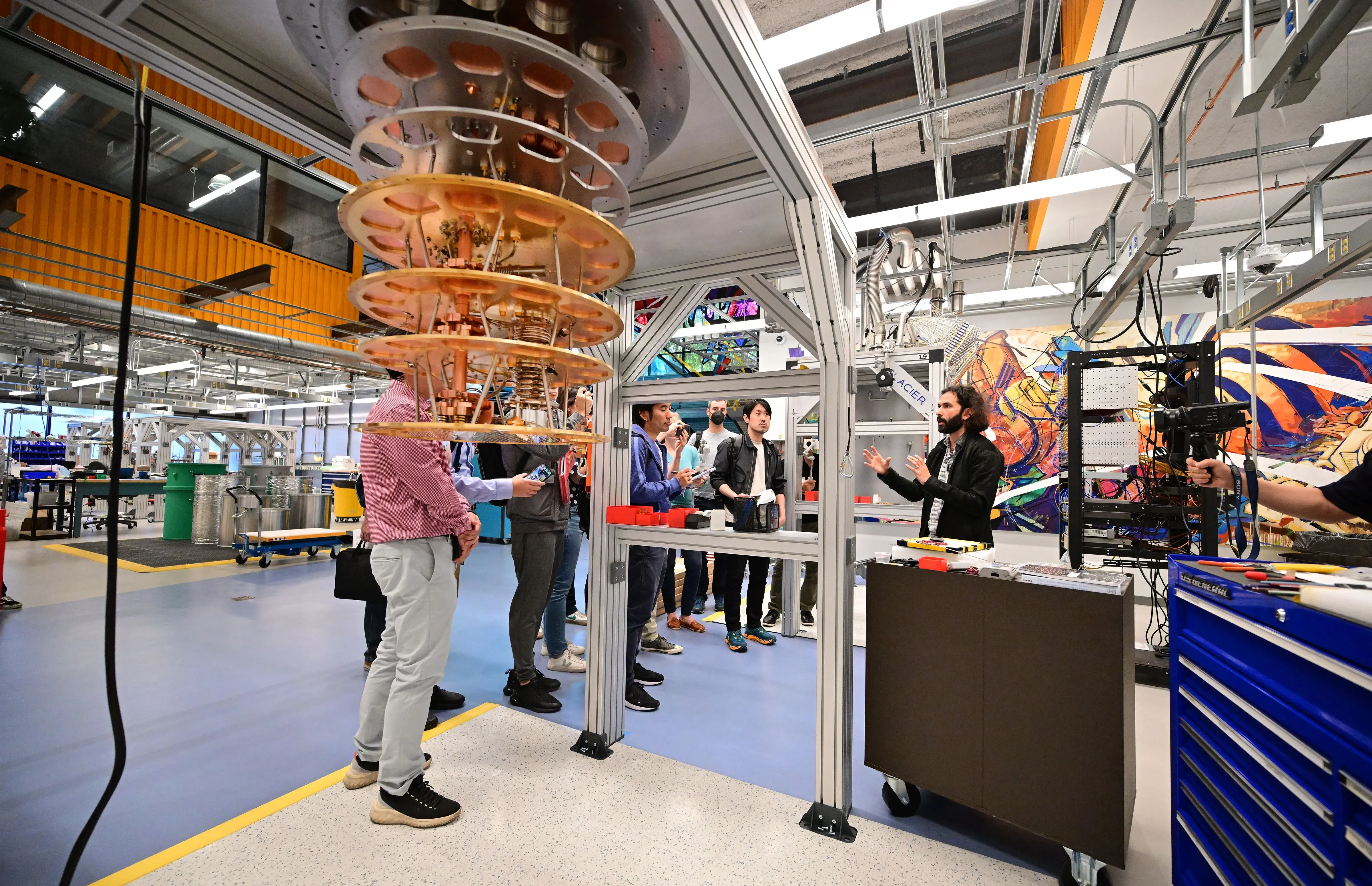
Using a powerful 58-qubit quantum computer, they created a totally new phase of matter that only appears when a system is pushed far away from its normal, stable state.
These unusual states, called non-equilibrium phases, don’t sit still like ice or water. Instead, they are defined by how they constantly change over time.
In particular, the researchers explored what’s known as a Floquet system—a quantum system that’s driven in regular cycles, almost like a beat in music.
This rhythmic drive lets matter take on entirely new forms that can’t exist in ordinary conditions.
Quantum Computers as Discovery Machines
In their experiment, the team realized a phase called a Floquet topologically ordered state, which had been predicted by theory but never seen before.
They were even able to watch strange particle-like effects unfold at the edges of the system, confirming long-standing ideas in physics.
One highlight was observing exotic “particle transmutations,” a bizarre process where these quantum particles seem to change their nature as they evolve.
“Highly entangled non-equilibrium phases are notoriously hard to simulate with classical computers,” said lead author Melissa Will, a PhD student at TUM.
“Our results show that quantum processors are not just computational devices – they are powerful experimental platforms for discovering and probing entirely new states of matter.”
This breakthrough is more than just a scientific curiosity. It shows that quantum computers can act like laboratories, helping scientists explore realms of physics that were once thought unreachable.
Beyond reshaping our understanding of the universe, these discoveries may eventually spark the next generation of quantum technologies.